
Meet our engineering team at Toy Biz International 2026 — 4 to 7 July 2026, Pragati Maidan, New Delhi, India • OEM & ODM tooling slots now open for the 2026 export season
Sourcing a Kids Puppy House Coin Bank in 2026 requires more than comparing factory prices. Buyers must examine material safety, decoration durability, packaging efficiency, and children’s product documentation. The category sits between toys, gifts, and early money-learning products, so demand data can be difficult to isolate. That limitation matters.
Circana’s global toy research continues to show that value, play relevance, and collectible appeal influence purchasing decisions. The Toy Association also emphasizes safety, age grading, and responsible product testing across children’s merchandise. These findings support a practical sourcing method: request samples, inspect moving parts, test paint adhesion, and measure carton protection before placing a wholesale order. A small puppy-shaped house should still survive repeated handling.
Richard Gottlieb, founder of Global Toy Experts, describes successful toy products as those that “deliver play value and emotional connection.” His observation applies to this category, although a coin bank must also offer clear functional value. Buyers should compare ceramic, resin, and durable plastic models, while checking whether the coin slot accepts common currency and whether the access plug remains secure.
Wholesale success is not guaranteed by a cute photo. It depends on repeatable quality, transparent supplier communication, and realistic landed-cost calculations. Some market forecasts combine toys, gifts, and home décor, making their figures imperfect for this niche. Treat them as directional evidence, not absolute truth. A careful 2026 sourcing plan should balance trend appeal with documented experience, verified testing, and honest supplier claims.
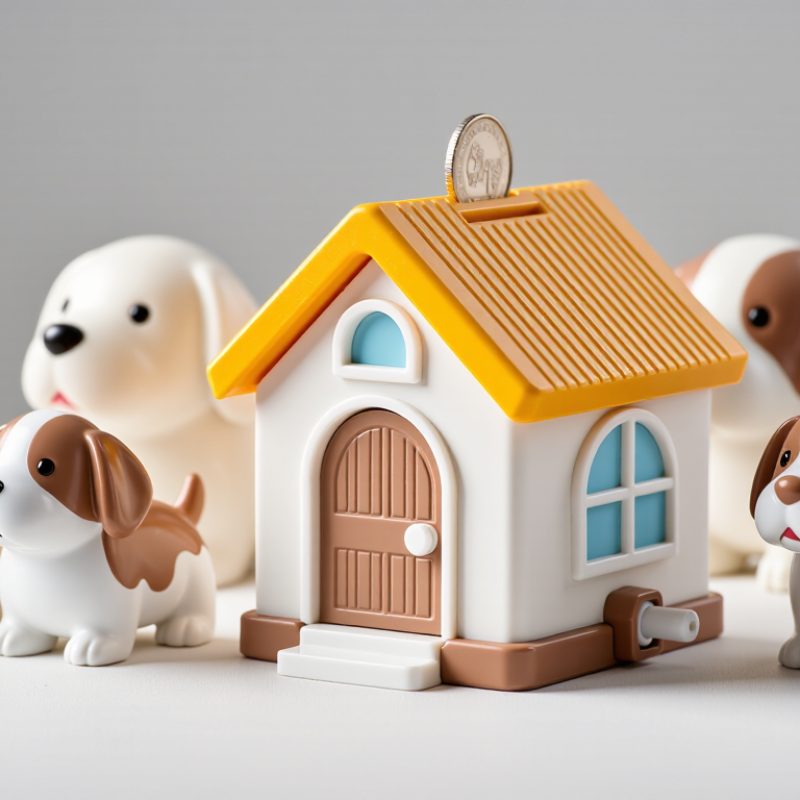
How to Source Kids Puppy House Coin Banks Wholesale in 2026
The global kids’ toy market is expected to exceed $100 billion in 2026. That scale creates opportunity, but also noise. Buyers must separate durable products from attractive samples that fail during regular use.
Kids puppy house coin banks fit several active trends: pretend play, room decoration, saving habits, and giftable learning products. When reviewing suppliers, request a physical sample first. Check the coin slot with different coin sizes. Open the retrieval door repeatedly. Inspect paint edges, hinges, odors, and small detachable parts. These details matter more than a polished catalog image.
Ask for material specifications, age guidance, and independent safety test reports. Requirements vary by destination, so confirm current rules with a qualified compliance professional. Compare minimum order quantities, carton dimensions, packaging strength, production timing, and landed cost. A low unit price may hide expensive damage in transit. Use neutral packaging when selling to multiple retailers. It can reduce redesign costs.
A useful wholesale target includes bright but balanced colors, a stable base, smooth rounded edges, and a clear opening mechanism. Avoid features that feel clever but frustrate children. Some suppliers promise fast customization, yet their first samples may look uneven. That is not always a deal breaker, but it requires correction before ordering. Keep written approval records, inspect a pre-shipment sample, and reserve time for delays. Small errors become expensive when thousands of units arrive.
When sourcing kids puppy house coin banks wholesale for 2026, set targets before requesting quotations. A practical opening MOQ may range from 300 to 1,000 pieces. Smaller orders often increase unit cost, while larger orders can create slow-moving inventory. Ask for pricing at three quantities, not just one.
Lead time needs more space than the factory estimate suggests. Request samples within 7–10 days, then allow 25–45 days for production. Add another 10–20 days for shipping and inspection. Confirm decoration, packaging, carton size, and color approval in writing. A puppy house bank may look simple, but hand-painted details can delay a full batch.
Calculate margin from landed cost, not the factory price. Include product cost, packaging, freight, inspection, payment fees, and expected defects. A 15% margin can suit high-volume retail programs, while 25%–30% gives more room for promotions and returns. I still see buyers ignore damaged packaging. That mistake is expensive. For a realistic target, test one sample carton and record breakage before finalizing the MOQ. Review the forecast again. It may be too optimistic.
For 2026 wholesale sourcing, treat a kids’ puppy house coin bank as a toy if children may handle, open, or play with it. ASTM F963-23 requires testing for mechanical hazards, flammability, chemicals, and labeling. CPSIA also limits accessible lead to 100 ppm and lead in surface coatings to 90 ppm. EN 71 adds European checks, including mechanical safety, flammability, and migration of elements. A supplier’s general “CE” or “ASTM” statement is not enough. Request test reports matching the exact model, materials, colors, and factory.
The European Commission’s Safety Gate 2023 report recorded 3,412 product alerts across Europe. Toys remained a repeatedly monitored category, showing why visual inspection alone is weak evidence. Ask for laboratory reports from an ISO/IEC 17025-accredited facility, a children’s product certificate for U.S. sales, production-batch traceability, and photos of internal compartments.
Check the following details carefully:
A cute puppy shape can hide a poor seam.
Tips:
I would not rely on one passing sample; color changes, recycled plastic, or a new paint supplier can alter results. That uncomfortable gap deserves a second test before mass production.
Sources: U.S. CPSC, ASTM F963-23, CPSIA, and European Commission Safety Gate 2023 report.
When sourcing kids’ puppy house coin banks in 2026, compare material before chasing the lowest FOB quote. ABS offers crisp details and stronger impact resistance, while PP is lighter and usually more economical. Ceramic feels premium, but it increases breakage risk during export. The OECD Global Plastics Outlook reports that only 9% of plastic waste was recycled globally in 2019, so recycled-content options deserve careful supplier verification. Statista Market Insights estimates global toy revenue exceeded US$100 billion in 2024, keeping material efficiency important for large-volume buyers.
Capacity affects both perceived value and carton cost. A 500-unit trial should test 150–250 ml capacity, paint adhesion, coin-slot safety, and packaging strength. For 5,000 units, 300–500 ml models may improve shelf appeal, but they consume more material. Ask suppliers to quote 500, 1,000, and 5,000 units separately. FOB comparisons should show product price, mold charges, inner packaging, export cartons, inspection fees, and production lead time. My sourcing mistake was comparing unit prices before checking carton dimensions. Freight later changed the result.
Tips: Request material certificates, sample photos, and a pre-production sample. Confirm whether recycled content changes color consistency. Ask for drop-test results using the final retail box. Keep one approved sample with the purchase contract. Do not assume ceramic is automatically more valuable. A small, durable PP bank may sell better than a heavy decorative version.
Wholesale comparison for child-oriented puppy house coin banks. Prices are indicative 2026 FOB China ranges in USD per unit for standard designs, one-color or simple multi-color decoration, and basic export packing.
| Material / Construction | Typical Size | Approx. Coin Capacity | Child-Safety and Durability Profile | Decoration Options | Estimated Weight | FOB Unit Price 500 Units |
FOB Unit Price 1,000 Units |
FOB Unit Price 3,000 Units |
FOB Unit Price 5,000 Units |
Best-Fit Retail Channel |
|---|---|---|---|---|---|---|---|---|---|---|
| ABS plastic with removable plug | 12 × 9 × 10 cm | Approximately 250–350 coins | Lightweight and impact-resistant. Rounded edges are suitable for supervised children. The plug should be securely fitted and tested for pull resistance. | Injection color, pad printing, sticker label, simple transparent window | Approximately 95–125 g | US$1.35–1.75 | US$1.10–1.45 | US$0.88–1.20 | US$0.76–1.05 | Value gift sets, toy stores, school rewards |
| PP plastic, one-piece molded body | 11 × 8 × 9 cm | Approximately 180–280 coins | Good chemical resistance and low weight. A recessed coin slot helps reduce sharp exposed edges. Suitable for economical promotional programs. | Screen printing, in-mold color, heat-transfer graphic | Approximately 70–100 g | US$1.05–1.40 | US$0.86–1.15 | US$0.70–0.96 | US$0.61–0.84 | Promotional campaigns, party favors, budget programs |
| PVC soft rubber with ABS inner shell | 12 × 9 × 10 cm | Approximately 220–320 coins | Soft-touch exterior improves grip and scratch resistance. The inner shell adds shape stability. Avoid small detachable decorations for products intended for young children. | 3D molded details, raised logo, spot color, custom character finish | Approximately 150–190 g | US$2.20–2.90 | US$1.85–2.45 | US$1.55–2.05 | US$1.38–1.82 | Novelty gifts, children’s boutiques, character collections |
| Ceramic stoneware with glazed finish | 13 × 10 × 11 cm | Approximately 300–450 coins | Stable and premium-looking but breakable. Best for older children, decorative use, or supervised gifting. Protective inner packaging is required. | Decal, hand-painted accents, full-color transfer, matte or glossy glaze | Approximately 550–750 g | US$3.20–4.30 | US$2.80–3.75 | US$2.40–3.25 | US$2.15–2.95 | Gift shops, home décor, premium seasonal displays |
| Aluminum alloy with steel access plate | 12 × 9 × 10 cm | Approximately 250–350 coins | Durable and difficult to crack, but heavier than plastic. Check exposed metal edges, coating adhesion, and the security of the access plate before children’s use. | Powder coating, laser engraving, UV print, embossed details | Approximately 280–380 g | US$3.60–4.80 | US$3.15–4.25 | US$2.70–3.70 | US$2.45–3.35 | Premium gifts, commemorative programs, desk accessories |
| MDF wood with water-based painted finish | 14 × 10 × 12 cm | Approximately 350–500 coins | Warm tactile appearance and good stability. Corners should be rounded, surfaces sealed, and paint tested for adhesion and restricted substances. | Screen printing, laser engraving, printed paper wrap, two-tone paint | Approximately 320–450 g | US$2.60–3.50 | US$2.20–3.00 | US$1.85–2.55 | US$1.65–2.30 | Educational gifts, craft retailers, eco-themed collections |
| Tinplate metal with printed outer shell | 13 × 9 × 10 cm | Approximately 250–350 coins | Light and stackable with good print quality. Folded seams must be smooth, and the coin opening should not expose sharp edges. | Full-color lithographic print, matte varnish, spot gloss, embossing | Approximately 170–240 g | US$1.90–2.55 | US$1.60–2.15 | US$1.34–1.82 | US$1.20–1.65 | Bookstores, museum shops, seasonal gift promotions |
When sourcing kids’ puppy house coin banks wholesale in 2026, request production samples before discussing a large order. Check the coin slot with several coin sizes, open and close the stopper, and inspect seams around the roof and base. Run a finger along every edge. Look for rough plastic, loose parts, strong odors, or paint that rubs off on a clean cloth. A polished sample can still hide production inconsistencies, so ask whether it matches the materials and finish planned for the full batch.
Packaging deserves the same scrutiny. Ask for the actual retail box and master carton, not just a digital mock-up. Check that the bank stays still inside its insert and that printed dimensions, item counts, and handling marks are clear. Request a packed sample for a basic drop and vibration check. Small details matter. A cracked roof or scuffed face can turn an otherwise sound order into costly returns.
Before approving bulk production, obtain third-party test reports for the exact product and materials being quoted. Confirm the report identifies the sample, test date, and laboratory, and ask which safety properties were assessed. Ask for proof. If colors, coatings, or components change, request confirmation that the existing results still apply. I might be tempted to trust a supplier’s neat paperwork too quickly; matching documents to the physical sample takes extra time, but skipping that check leaves important questions unanswered.
Recommended internal completion targets before approving a wholesale order. These are planning benchmarks, not universal regulatory limits.
Approve bulk production only after the production sample matches the approved sample, packaging checks are documented, and applicable third-party test reports and product labels have been reviewed for the destination market.
A practical starting MOQ is 300–1,000 pieces. Request prices at three quantities. Larger orders may lower unit costs but leave you with slow-moving stock.
Allow 7–10 days for samples, 25–45 days for production, and 10–20 days for shipping and inspection. Hand-painted roofs may take longer.
Calculate landed cost, including freight, packaging, inspection, payment fees, and likely defects. A 15% margin may suit high-volume sales; 25%–30% offers more room for promotions and returns.
Request reports for the exact model, materials, colors, and factory. Depending on the market, relevant checks may include ASTM F963-23, CPSIA, and EN 71. A general compliance statement is not enough.
Check roof and base seams, sharp edges, loose knobs, paint flakes, odors, and accessible compartments. Test the stopper repeatedly. One passing sample may not reflect every production batch.
Rub painted areas with a clean, damp cloth. Look for color transfer or flakes. A small test helps, but it cannot answer every material-safety question.
Request the actual retail box and master carton. Confirm the bank stays secure in its insert, then check dimensions, item counts, and handling marks. Small details matter.
Obtain reports before approving bulk production. Match the report to the physical sample, test date, materials, and laboratory. Changes to paint or components may need another review.
Request a packed sample for a basic drop and vibration check. Record any cracks or scuffs. One test carton may still miss problems in a full shipment.
Sourcing a Kids Puppy House Coin Bank wholesale in 2026 requires a clear understanding of the expanding global children’s toy market, which is projected to exceed $100 billion. Buyers should establish practical wholesale targets before contacting suppliers, including order quantities, expected lead times, landed-cost limits, and a target profit margin of approximately 15%–30%. For orders between 500 and 5,000 units, compare FOB quotations carefully while evaluating material quality, coin capacity, durability, appearance, and production consistency.
Supplier screening should include documented compliance with ASTM F963-23, EN 71, and CPSIA requirements where applicable to the destination market. Before placing a bulk order, request production samples and inspect the product, inner packaging, shipping cartons, labels, and safety information. Independent third-party testing can help verify material safety, mechanical performance, and packaging suitability. A structured comparison of samples, certifications, pricing, capacity, and delivery reliability will reduce purchasing risks and support a dependable wholesale launch.