
Meet our engineering team at Toy Biz International 2026 — 4 to 7 July 2026, Pragati Maidan, New Delhi, India • OEM & ODM tooling slots now open for the 2026 export season
Choosing a sustainable toy supplier takes more than a green label. Buyers need evidence behind the material, factory process, and product claims. Sustainable Plastic Toy Manufacturing can reduce reliance on virgin plastics, but recycled content alone does not prove a toy is durable or responsibly made. The details matter: resin traceability, clear material specifications, sturdy joints, and packaging that avoids unnecessary layers.
The scale of the challenge is significant. The OECD’s Global Plastics Outlook (2022) estimates that global plastic production reached 460 million tonnes in 2019. That year, plastic waste totaled 353 million tonnes, and only 9% was ultimately recycled. These figures cover the whole plastics economy, not toys alone. Still, they show why buyers should ask manufacturers for measurable evidence rather than broad promises. A practical test.
Sustainable-design expert William McDonough’s principle, “Waste equals food,” offers a useful lens for product design. For toy buyers, that means asking whether materials can be identified, separated, and recovered after use. It also means checking product testing, recycled-resin documentation, factory quality controls, and supplier transparency. No material is perfect. Recycled plastics can vary, and a toy that breaks quickly may create more waste than expected. This guide compares manufacturers through those practical questions, helping global buyers assess capabilities, trade-offs, and the evidence each supplier can provide. The best choice is not always the one with the boldest claim.
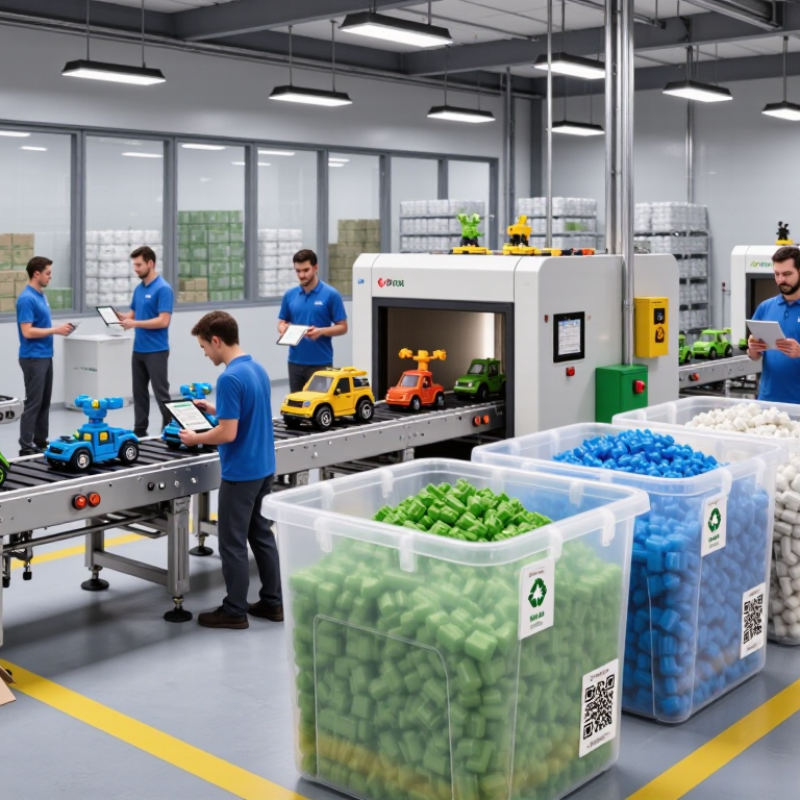
A sustainable plastic toy manufacturer can explain what each material is, where it comes from, and how it is used. Clear records matter more than broad claims. Buyers should ask for material specifications, recycled-content percentages, and batch-level traceability. These details help confirm whether a claim applies to the whole toy or only one component.
The design should also support durability and practical use. A sturdy hinge, smooth edges, and parts that resist cracking can keep a toy in service longer. Manufacturers should document relevant safety testing and explain how they control colorants, coatings, and small components. Ask how products are checked during production, not only before shipment. Good answers are specific.
No process is flawless. Recycled plastic can vary between batches, so color and texture may shift slightly. That trade-off should be disclosed, not hidden. Responsible manufacturers can describe their quality checks, packaging choices, and waste controls, while acknowledging areas still being improved. Buyers can request recent test reports, supplier declarations, and examples of corrective actions. Small details count. A supplier’s willingness to share evidence—and admit limits—often tells more than a sustainability slogan.
Sustainable toy manufacturing begins with choosing materials suited to each part. Recycled polypropylene may work well for sturdy blocks, while softer components can require different formulations. Bio-based plastics are not automatically biodegradable; their performance depends on composition and disposal conditions. That matters. Buyers should ask suppliers for material specifications, recycled-content records, and test results for the finished toy, not just the raw resin. Colorants and coatings also need review, since they can affect recyclability and product durability.
Production methods shape the environmental impact too. Efficient injection molding can reduce scrap, especially when factories measure rejected parts and reuse suitable clean material. Careful mold design helps prevent defects such as sharp seams or uneven edges. Energy monitoring, machine maintenance, and water-use tracking provide useful evidence of improvement. A factory visit can reveal details a brochure misses: labeled material bins, organized regrind, and documented quality checks. Still, recycled feedstock can vary in color and strength. Not always. Manufacturers may need extra sorting or process adjustments, and those steps have costs. Buyers should compare durability, traceability, and production data alongside price, then request samples for practical handling tests.
| Material or Approach | Typical Feedstock | Common Toy Applications | Potential Sustainability Benefit | Production Considerations | What Buyers Should Verify |
|---|---|---|---|---|---|
| Recycled polypropylene (rPP) | Post-consumer or post-industrial polypropylene, sorted and reprocessed into resin. | Blocks, playsets, storage components, and other injection-moulded parts. | Can reduce demand for virgin resin and divert suitable plastic from disposal; the benefit depends on the feedstock and processing route. | Injection moulding is commonly used. Colour variation and changes in flow or impact performance may require material testing and process adjustment. | Documented recycled-content percentage, traceability, material consistency, and testing of the finished toy to applicable market requirements. |
| Recycled high-density polyethylene (rHDPE) | Reprocessed HDPE from selected post-consumer or post-industrial sources. | Large moulded parts, wheeled toys, outdoor play components, and containers. | Uses recovered polymer in place of some virgin HDPE when suitable recycled feedstock is available. | Injection moulding and extrusion blow moulding are established processes for HDPE. Contamination and variation in recycled feedstock can affect appearance and performance. | Feedstock origin, recycled-content records, colour and odour controls, and product-specific mechanical and chemical-safety test results. |
| Recycled PET (rPET) | Reprocessed PET, often sourced from collected packaging streams; the source should be specified by the supplier. | Packaging, textile-like components, and selected moulded or sheet-based toy parts. | Can put recovered PET to use and reduce the need for virgin PET, subject to collection, sorting, and processing impacts. | Sheet extrusion and thermoforming can be used for suitable designs. Moisture control and material-grade selection are important during processing. | Whether the material is intended for the proposed application, recycled-content evidence, and compliance testing for the complete finished product. |
| Bio-based polyethylene (bio-PE) | Polyethylene made from renewable-origin feedstock, such as sugarcane-derived ethanol; it is chemically similar to conventional PE. | Injection-moulded or blow-moulded parts designed for polyethylene. | Can reduce reliance on fossil feedstock. Bio-based origin does not by itself mean the plastic is biodegradable or compostable. | Many conventional PE processing methods may be suitable, but suppliers should confirm the grade and processing window for the intended part. | Bio-based-content evidence, feedstock-chain documentation, grade data, and accurate end-of-life claims for the finished product. |
| Polylactic acid (PLA) | Bio-based polymer commonly produced from fermented plant-derived sugars or starches. | Selected rigid parts, prototypes, and products designed for the properties of the specific PLA grade. | Can be made from renewable feedstock. Bio-based content does not automatically establish lower life-cycle impact or home-compostability. | Injection moulding and additive manufacturing are possible for suitable grades. Heat resistance and impact performance vary by formulation and should be assessed for the toy’s use conditions. | Grade-specific performance, applicable toy-safety test results, and clear evidence for any compostability or disposal claim. |
| Design for repair, durability, and recyclability | Design and manufacturing choices applied to the selected plastic and any associated materials. | Multi-part toys, products with replaceable components, and toys intended for repeated use. | Longer useful life and simpler material separation can support waste reduction, depending on consumer use and local recycling infrastructure. | Use compatible materials where practical, limit unnecessary coatings and mixed-material assemblies, and design joints for reliable assembly or repair. | Durability testing, spare-parts availability, material identification, disassembly instructions, and realistic end-of-life guidance for target markets. |
Buyer note: Material selection alone does not establish toy safety or environmental performance. Request current, product-specific documentation and verify applicable requirements in each destination market, such as EN 71 in the EU or ASTM F963 and relevant U.S. requirements. Certification, recycled-content claims, and recyclability depend on the exact product, evidence, and market conditions.
When comparing sustainable plastic toy manufacturers, ask for traceable material records, not broad “eco” claims. OECD’s Global Plastics Outlook (2022) reports that plastic production reached 460 million tonnes in 2019, while only 9% of plastic waste was ultimately recycled. Numbers matter. Buyers should request resin specifications, recycled-content evidence, and batch-level documentation. Check whether the supplier can explain where materials come from and how claims are verified.
Product performance matters too. Ask for independent test reports covering small parts, impact resistance, and repeated use. Compare sample toys after drops, wash cycles, and rough handling; a cracked part can erase the value of recycled content. Request details on colorants, surface coatings, and material consistency between production batches. Ask for proof. A certificate alone may not show how a specific toy was tested. Requirements also vary by market, so confirm that reports match the intended destination and age range.
Review factory controls alongside the product. Compare scrap rates, energy and water monitoring, packaging weight, and documented supplier audits. Ask how rejected pieces are handled, rather than accepting a general recycling promise. Request production samples and clear corrective-action records. No checklist is perfect. Smaller suppliers may have thinner documentation, and a polished report can still miss shop-floor problems. A practical comparison combines records, independent testing, and direct observation where possible. Weigh durability and repairability against material claims; buyers sometimes overlook the toy’s full service life.
Top Sustainable Plastic Toy Manufacturers for Global Buyers
Leading Sustainable Plastic Toy Manufacturers for Global Buyers
Choosing a sustainable toy manufacturer takes more than checking whether a product contains recycled plastic. Buyers should ask for material traceability, batch records, and independent test reports. Small details matter: Does a recycled resin keep its color and strength across production runs? Can parts be separated for repair or recycling? A supplier’s clear answers are more useful than broad environmental claims.
The OECD’s Global Plastics Outlook (2022) estimates that the world generated 353 million tonnes of plastic waste in 2019; only 9% was recycled. That figure covers all plastics, not toys, but it shows why material choices and waste controls deserve scrutiny. Manufacturers can explain the origin and recycled content of their resin, document production scrap, and provide testing against relevant toy-safety requirements. Ask how samples were tested, not just whether they passed.
Look closely at durability. A brightly colored block that cracks after a few weeks is not a sustainable choice. UNEP’s Turning off the Tap report (2023) describes reuse and recycling among ways to reduce plastic pollution, but design and collection systems both matter. Trade-offs remain: recycled feedstock may vary, and recyclable parts are not always collected locally. Get specifics. A supplier willing to discuss these limits may be more credible than one promising a perfect solution.
How plastic waste was managed worldwide in 2019. These figures provide context for evaluating more circular material choices; they are not specific to toys or toy manufacturers.
Shares are rounded. Source: OECD, Global Plastics Outlook (2019 data).
Global buyers should assess toy suppliers through both environmental evidence and destination-market safety requirements. The OECD’s Global Plastics Outlook reports that 353 million tonnes of plastic waste were generated in 2019; only 9% was ultimately recycled. That figure makes recycled content worth checking carefully. Ask for material specifications, batch-level traceability, and evidence supporting any recycled-content claim. A tidy certificate is not enough.
Safety standards vary by market and product type. Buyers commonly request testing against EN 71, ASTM F963, or the ISO 8124 series, as applicable. These standards address hazards such as small parts, mechanical strength, and chemical migration. Requirements can differ by age grading and sales destination. Request current test reports for the actual toy, not a similar sample. Check that the laboratory and report scope match the product. Small details matter.
Environmental management certification, such as ISO 14001, can indicate structured site practices, but it does not certify a toy as sustainable. Ask how factories manage scrap, energy, and wastewater, then compare answers with records. The UNEP report Turning off the Tap (2023) estimates that existing solutions could reduce global plastic pollution by 80% by 2040. Supplier decisions are part of that shift, though the paperwork may still leave gaps. Recycled materials can also vary between batches, so confirm color, strength, and safety again before scaling an order.
It should provide material specifications, recycled-content percentages, and batch-level traceability. Clear records matter.
Ask which components contain recycled plastic. Request records for each part, not just the raw material.
No. Their performance depends on composition and disposal conditions. The label alone is not enough.
Strong hinges, smooth edges, and crack-resistant parts can extend use. Test samples by handling them.
Ask how parts are inspected during production and before shipment. Request recent test reports.
Yes. Color and texture may shift slightly. Not always predictable.
Look for labeled material bins, measured scrap, and records of suitable clean material being reused.
Supplier declarations, production data, and examples of corrective actions. Honest limits count too.
Sustainable Plastic Toy Manufacturing combines responsible material choices with efficient, carefully controlled production. Manufacturers may use recycled or bio-based plastics where appropriate, reduce excess packaging, and design toys for durability, repair, or recycling. Strong environmental practices also include managing energy and water use, limiting production waste, and maintaining clear records of material sourcing and manufacturing processes.
For global buyers, comparing manufacturers means looking beyond price to assess product quality, production capacity, communication, traceability, and environmental commitments. Buyers should also review relevant safety testing, quality systems, and certifications, while confirming that products meet the requirements of their intended markets. A thoughtful sourcing process balances sustainability with safety, reliability, and consistent performance, helping buyers select manufacturing partners suited to their product needs and long-term goals.