
Meet our engineering team at Toy Biz International 2026 — 4 to 7 July 2026, Pragati Maidan, New Delhi, India • OEM & ODM tooling slots now open for the 2026 export season
Global toy buying is changing quickly, but dependable manufacturing still begins with clear evidence. Circana’s 2023 Global Toy Industry report recorded worldwide toy sales of approximately $108.7 billion, a 7% decline from the previous year. That pressure makes supplier selection more important. Buyers now examine tooling costs, minimum order quantities, material consistency, testing records, and delivery performance.
OEM Plastic Toy Manufacturing is not simply a low-cost production process. It involves product engineering, mold design, plastic selection, color matching, assembly, packaging, and quality control. The Toy Association has also emphasized the continuing importance of safety, innovation, and responsible production across the toy sector. Details matter. A bright sample may hide weak hinges, uneven seams, or inconsistent dimensions inside a large shipment.
Dr. Amanda Gummer, founder of The Good Play Guide, has stated, “Play is not a luxury; it is a necessity.” That perspective reminds global buyers that plastic toys must support safe, meaningful play, not only attractive pricing. The manufacturers listed in this guide are assessed through practical buyer concerns, including technical capability, communication, customization, compliance support, and production capacity. A perfect supplier does not exist. Even experienced factories can show weaknesses in documentation, forecasting, or after-sales communication. Therefore, buyers should verify current certifications, request production samples, and inspect critical components before placing large orders. These ten OEM plastic toy manufacturers offer useful starting points for comparison, but careful due diligence remains essential.
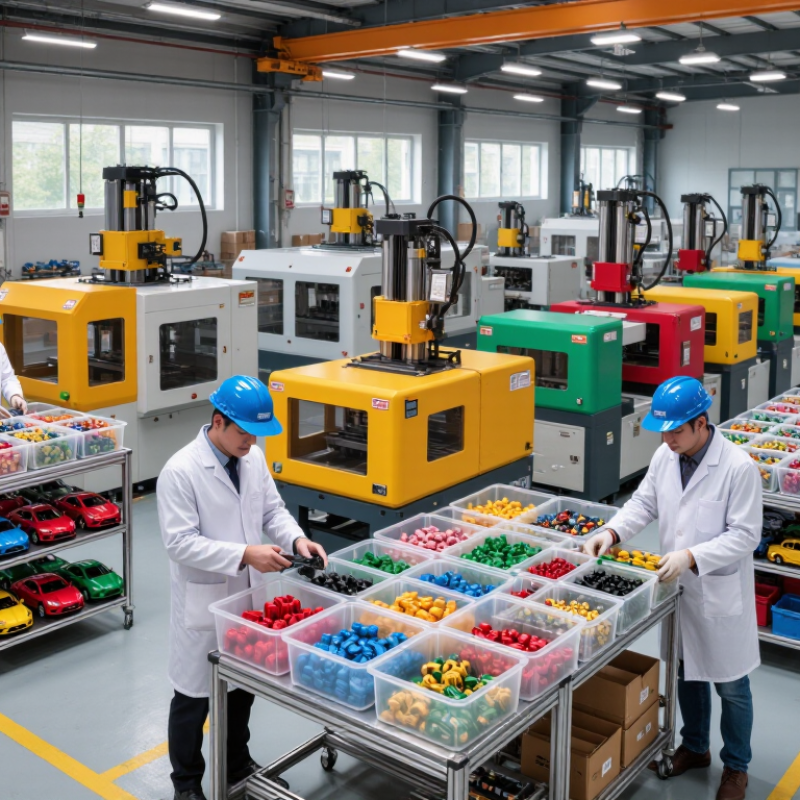
OEM plastic toy manufacturing means producing toys to a buyer’s specifications, rather than selling an existing factory design.
The buyer may provide drawings, safety requirements, colors, packaging, or a complete concept. The manufacturer then manages mold development, plastic selection, injection molding, assembly, decoration, and quality inspection. A small figure can require several molds, manual trimming, and repeated color checks under neutral lighting.
The market remains large, but demand is less predictable. Circana’s 2023 Global Toy Industry report recorded a 7% sales decline across its tracked markets. Grand View Research also identifies plastic products as a major segment within the global toys market.
These figures matter to OEM buyers because changing demand affects mold investment, minimum order quantities, and inventory risk. A cheaper quote may hide expensive tooling or weak after-sales controls.
Experienced suppliers normally test materials, paint adhesion, small parts, sharp edges, and mechanical strength. ISO 8124 provides widely used international toy-safety guidance, while ASTM F963 is applied in the United States. Requirements still differ by destination.
Documentation must match the actual batch, not only a sample. That sounds obvious, yet it is often overlooked. Recycled plastic can reduce virgin material use, but its color consistency and chemical documentation require closer review.
Factory audits, retained samples, and third-party laboratory reports add cost, but they make production decisions more reliable. The process is efficient, not flawless. Human inspection can still miss a loose accessory or uneven printed detail.
Choosing an OEM plastic toy manufacturer starts with evidence, not polished catalogs. Ask for factory photos, production records, and recent test reports for the exact toy category. A capable supplier should explain resin selection, mold design, color matching, and assembly controls clearly. Request a sample from regular production, not a showroom piece. Inspect seams, sharp edges, loose parts, paint coverage, and odor. Small defects often reveal weak process control.
For global sourcing, verify compliance before discussing large volumes. Check testing for restricted substances, mechanical safety, flammability where relevant, and age-grade requirements in destination markets. Independent laboratory reports should show product identity, test dates, and traceable sample information. Also review business licenses, audit findings, worker-safety practices, and subcontracting rules. A factory may outsource molding or printing without saying so. That gap matters. Ask who owns the tooling, who approves material changes, and how rejected batches are quarantined.
Cost comparisons need more than unit price. Calculate tooling, packaging, inspection, freight, and late-correction costs. During a pilot order, measure dimensions, weight, carton-drop results, and defect rates against written tolerances. Keep approval samples and signed specifications. Communication is another practical test. Send a confusing color reference or revised drawing, then observe the questions you receive. Good engineers clarify. Weak teams simply agree. No supplier is perfect. I would allow a controlled sampling mistake, but not repeated silence after corrective action. Choose the manufacturer that documents problems and fixes them consistently.
This neutral buyer scorecard uses a 100-point evaluation model for comparing OEM plastic toy manufacturers. The highest weights are assigned to product safety and quality systems, followed by production capability, tooling expertise, lead-time reliability, export compliance, sustainability, and commercial terms. Buyers should verify each criterion with current certificates, factory audits, samples, test reports, and production records.
Choosing among the 10 best OEM plastic toy manufacturers requires more than comparing prices. Production capability should match the toy’s design, volume, and target market. Ask whether the factory controls mold development, resin selection, color matching, and assembly in-house. A reliable supplier should provide production samples before mass manufacturing. Check small details, such as uneven seams, loose wheels, sharp edges, and inconsistent wall thickness.
Safety evidence matters. Request material declarations, batch records, and test reports from qualified laboratories. Depending on the destination, products may need testing against standards such as EN 71, ASTM F963, or ISO 8124. These requirements can change by age grade and market. Confirm that paint, plastic, magnets, and small components are evaluated separately when necessary. A factory that only shows a general certificate may be avoiding important details.
Quality control should continue after approval samples. Inspect first articles, monitor injection molding temperatures, and keep traceable records for each batch. Ask how rejected parts are isolated and how corrective actions are verified. Factory audits, worker training records, and shipment inspections add useful evidence. Still, no system is perfect. I have seen attractive samples hide weak packaging or poor color consistency during larger runs. A written quality agreement, clear tolerances, and independent pre-shipment inspection can reduce that risk. Leave room for rechecking assumptions.
Global buyers increasingly judge OEM plastic toy manufacturers by measurable capability, not attractive catalogs. Grand View Research valued the global toys market at about USD 108.7 billion in 2023, with continued growth projected through 2030. This pressure rewards suppliers that control tooling, injection molding, color matching, and production consistency. The top ten manufacturers typically show different strengths: rapid prototyping, low minimum orders, automated molding, recycled-material options, complex assembly, private-label packaging, or export logistics. Some also provide in-house engineers who adjust wall thickness and draft angles before tooling begins. That practical support can reduce costly mold revisions.
Safety remains a critical differentiator. The U.S. Consumer Product Safety Commission reports that toy-related injuries still affect hundreds of thousands of children annually in the United States. Reliable factories therefore maintain documented testing for applicable requirements, including ASTM F963, EN 71, or ISO 8124. Their strengths should include traceable resin batches, age-grade reviews, pull testing, drop testing, and inspection records. Certifications help, but they are not magic. A supplier may pass one sample and still struggle with later batches. Buyers should examine production history, corrective-action reports, and independent laboratory results.
Tips: Request a pilot run before committing to volume. Compare first-article samples under identical lighting. Ask for mold ownership terms, defect thresholds, lead times, and backup production plans. Check whether sustainability claims include recycled-content evidence. A lower quotation may hide weaker inspection or expensive tooling changes. In my experience, the best supplier is not always the largest; it is the one that communicates clearly when a design needs improvement. That honesty can prevent bigger problems.
Selecting the right OEM plastic toy manufacturer requires more than comparing price lists. Review the factory’s experience with similar toys, plastic types, molds, painting, and assembly. Ask for recent production samples, not only polished catalog photos. Inspect edges, seams, moving parts, and paint coverage closely. Small defects often reveal weak process control.
Request clear information about tooling ownership, minimum order quantities, production capacity, and lead times. A reliable manufacturer should explain how it manages material inspection, in-process checks, final sampling, and corrective actions. Confirm that its testing process supports the safety requirements of your target markets. Ask for relevant test reports and traceable quality records.
Communication also matters. Send a detailed specification sheet with dimensions, colors, tolerances, packaging, and acceptable defect limits. Then compare the factory’s questions. Careful questions usually indicate stronger technical understanding. Fast replies are useful, but vague replies are not.
Ask why. Check twice.
Factory audits can reveal storage problems, crowded workstations, or inconsistent housekeeping. These details may affect quality later. However, an audit is only a snapshot, and I have learned not to treat it as proof of perfect performance. Start with a small pilot order when possible. Measure defect rates, delivery accuracy, packaging strength, and response time before expanding. The cheapest quote may become expensive after mold changes, rework, delays, or rejected shipments. A balanced decision considers total cost, product safety, communication, and long-term reliability.
| Rank | Anonymous Manufacturer Profile | Primary Production Region | Core Plastic Processes | Typical MOQ | Common Materials | Compliance Support | Tooling Approach | Best Fit for Buyers | Indicative Lead Time | Selection Score |
|---|---|---|---|---|---|---|---|---|---|---|
| 01 | High-Volume Injection Specialist | East Asia | Injection molding, overmolding, ultrasonic assembly | 5,000–20,000 units per SKU | PP, ABS, PVC, TPE | ASTM F963, CPSIA, EN 71 testing coordination | Customer-owned or supplier-assisted tooling | Large retail programs and repeat orders | 45–75 days after approval | 9.4/10 |
| 02 | Low-MOQ Product Development Partner | Southeast Asia | Injection molding, 3D printing, hand assembly | 500–3,000 units per SKU | PP, ABS, HIPS, TPE | Third-party safety testing and technical files | Prototype-first, staged tooling investment | Start-ups, test launches, and crowdfunding | 35–60 days after approval | 9.1/10 |
| 03 | Complex Multi-Part Assembly Manufacturer | East Asia | Multi-shot molding, insert molding, assembly | 3,000–10,000 units per SKU | ABS, PP, PC, POM, TPE | EN 71, ASTM F963, REACH and phthalate screening | Precision steel molds with replaceable inserts | Transforming toys and mechanical playsets | 50–85 days after approval | 9.0/10 |
| 04 | Eco-Material Toy Manufacturer | Southeast Asia | Injection molding, compression molding, finishing | 2,000–8,000 units per SKU | Recycled PP, bio-based plastics, TPE, ABS | Material declarations, REACH and EN 71 coordination | Conventional tooling with recycled-resin validation | Sustainability-focused educational toys | 45–80 days after approval | 8.8/10 |
| 05 | Educational Construction Toy Specialist | East Asia | High-precision injection molding, sorting, kitting | 5,000–15,000 units per SKU | ABS, PP, POM, PA | Dimensional inspection and toy-safety test coordination | High-cavity molds for consistent part tolerances | Building sets, STEM kits, and classroom products | 50–90 days after approval | 8.7/10 |
| 06 | Soft-Touch and Flexible Plastic Specialist | South Asia | TPE overmolding, injection molding, painting | 2,000–10,000 units per SKU | TPE, TPU, PVC, PP | Phthalate, heavy-metal and migration testing coordination | Two-material tooling with texture control | Bath toys, sensory toys, and infant accessories | 45–75 days after approval | 8.5/10 |
| 07 | Decoration and Finishing Specialist | East Asia | Injection molding, pad printing, spray coating | 3,000–12,000 units per SKU | ABS, HIPS, PP, PVC | Coating, ink and substrate safety documentation | Standard molds plus color and artwork approval gates | Character-style figures and highly decorated toys | 50–85 days after approval | 8.4/10 |
| 08 | Regional Export-Oriented OEM | Eastern Europe | Injection molding, assembly, packaging | 1,000–6,000 units per SKU | PP, ABS, HIPS, TPE | EN 71, REACH and EU packaging documentation | Existing tooling adaptation and moderate new tooling | European distribution and shorter regional logistics | 30–60 days after approval | 8.2/10 |
| 09 | Integrated Design-to-Production Partner | East Asia | Industrial design, prototyping, molding, assembly | 1,000–5,000 units per SKU | ABS, PP, PC, TPE, silicone | Risk assessment, technical files and laboratory coordination | Prototype validation before production tooling | Original concepts requiring engineering support | 60–100 days after approval | 8.1/10 |
| 10 | Private-Label Catalog Manufacturer | South Asia | Injection molding, basic assembly, private-label packaging | 300–2,000 units per SKU | PP, ABS, PVC, HIPS | Standard product test reports and buyer-requested testing | Existing molds with limited customization | Fast market entry and budget-conscious assortments | 25–55 days after approval | 7.9/10 |
Request factory photos, recent production samples, test reports, and production records. Catalog images are not enough. Check whether the evidence matches your exact toy category.
Ask for a sample from regular production, not a showroom sample. Inspect seams, sharp edges, loose parts, moving joints, paint coverage, and odor. Small defects can expose weak process control.
Request material declarations, batch records, and independent laboratory reports. Reports should show product identity, test dates, and traceable samples. Requirements may vary by age grade and destination market.
Ask about resin selection, mold development, color matching, assembly, and material inspection. Confirm who owns the tooling and approves material changes. Also ask whether molding, printing, or assembly is subcontracted.
Use written tolerances for dimensions, weight, color, packaging, and acceptable defects. Inspect first articles and monitor key molding conditions. Rejected parts should be isolated and recorded. Do not assume approval ends the risk.
Compare tooling, packaging, inspections, freight, rework, delays, and possible rejected shipments. A low unit price may hide expensive corrections later. Calculate the full project cost.
Send a detailed drawing with colors, measurements, tolerances, and packaging instructions. Then observe the questions you receive. Careful engineers clarify unclear details. Fast agreement is not always good communication.
Start with a controlled pilot order when possible. Measure defect rates, delivery accuracy, carton strength, and response time. Factory audits help, but an audit is only a snapshot. I would tolerate one controlled mistake, not repeated silence after correction.
OEM Plastic Toy Manufacturing enables businesses to develop customized toys through specialized production partners, covering design adaptation, mold development, material selection, mass production, packaging, and quality control. For global sourcing, buyers should evaluate manufacturers by examining their technical capabilities, communication, production capacity, lead times, sampling process, customization flexibility, and experience with international shipping. A reliable supplier should also demonstrate clear quality procedures and consistent project management.
When comparing manufacturers, buyers should review production safety, material compliance, durability testing, age grading, labeling, and packaging requirements for their target markets. The top ten manufacturer profiles in this guide are organized by practical strengths, such as advanced molding capabilities, efficient large-volume production, flexible low-volume support, innovative finishing, or strong quality assurance. Selecting the right partner requires balancing product complexity, order quantity, budget, schedule, customization needs, and compliance expectations. Careful factory assessment, sample approval, transparent communication, and written quality agreements can help reduce risk and build a dependable long-term supply relationship.